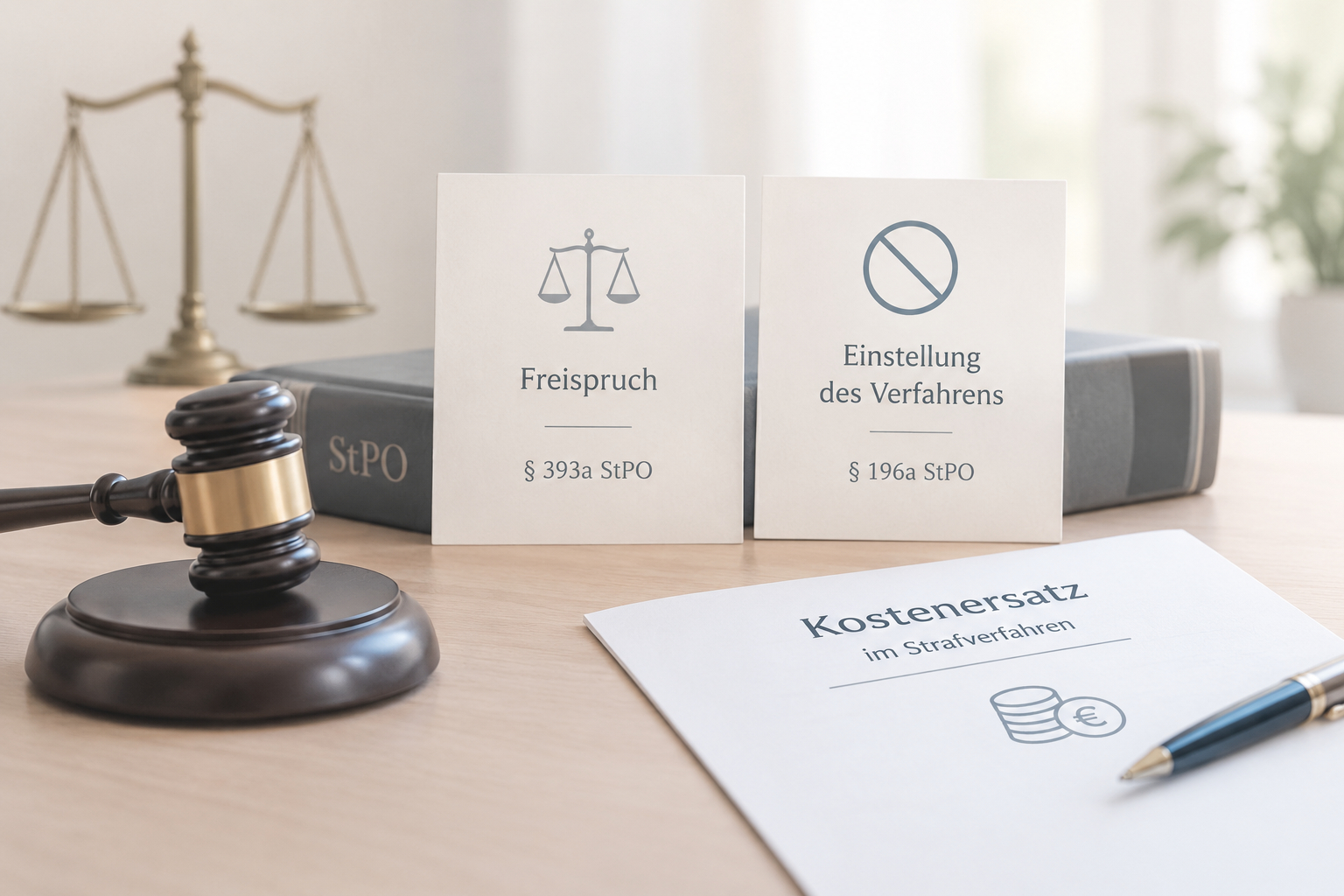
Anyone in Austria who becomes involved in criminal proceedings and is ultimately acquitted, or whose preliminary investigation is discontinued, may receive a contribution from the federal government toward defense costs and reimbursement for necessary out-of-pocket expenses. Since the amendment to the Code of Criminal Procedure in July 2024, the maximum amounts have been significantly increased, and for the first time, a cost contribution has been introduced in cases where the preliminary investigation is discontinued. In this article, you’ll learn what amounts you’re entitled to, how to submit your application, and what deadlines you need to keep in mind.
What is reimbursement of costs in criminal proceedings?
Cost reimbursement or a cost contribution in criminal proceedings is a legally regulated contribution by the federal government toward the costs of the defense—not a full reimbursement of the actual costs incurred. It is available to individuals who have been fully acquitted or whose preliminary investigation has been completely discontinued.
Reimbursement of expenses covers two areas:
- Out-of-pocket expenses incurred by the accused or defendant (e.g., costs for copies of documents, interpreter fees, travel expenses), which must be substantiated.
- A lump-sum contribution toward defense counsel fees (contribution toward defense counsel fees). In practice, a statement of costs is submitted for this purpose.
No contribution toward defence counsel fees is payable if the accused was represented under legal aid.
What was the legal position before the reform?
The previous maximum amounts were extremely low. In proceedings before a single judge of the Regional Court, the maximum was merely EUR 3,000.00, whilst the absolute upper limit (jury court) stood at EUR 10,000.00. In practice, the courts often awarded only around 10 per cent of the maximum amount, meaning that acquitted persons had to bear the bulk of their defence costs themselves.
The legislative materials on the reform expressly state that, given the new maximum amounts, there is no longer any reason to assume that an average case warrants only around 10 per cent of the maximum amount. The new legal position is therefore intended to bring a noticeable improvement for those affected.
How much is the reimbursement of costs following an acquittal?
Following a full acquittal, the new maximum amounts depend on the court that tried the case. The reform introduced by Federal Law Gazette (BGBl) I No 96/2024 has significantly increased the amounts under § 393a StPO:
| Type of court | Base amount | + 50 % | + 100 % |
| District court | EUR 5.000,00 | EUR 7.500,00 | EUR 10.000,00 |
| Single judge of the Regional Court | EUR 13.000,00 | EUR 19.500,00 | EUR 26.000,00 |
| Lay assessors’ court or jury court | EUR 30.000,00 | EUR 45.000,00 | EUR 60.000,00 |
| Discontinuation of the preliminary investigation (§ 196a StPO) | EUR 6.000,00 | EUR 9.000,00 | EUR 12.000,00 |
Note: Since the reform, a uniform maximum amount has applied to both lay assessors’ courts and jury courts.
When may the maximum amounts be exceeded?
The new maximum amounts may be exceeded in cases involving special circumstances. An increase of 50 per cent is permitted if the proceedings are of exceptional scope or particular complexity, for example where the maximum duration of the preliminary investigation has been exceeded. In cases of extreme scope, the amount may even be doubled (+100 per cent).
Relevant criteria include the duration of the trial, the complexity of the facts and the extent of the loss. In proceedings before a lay assessors’ court or a jury court, the reimbursement of costs may therefore amount to as much as EUR 60,000.00.
Is reimbursement of costs available following discontinuation of the preliminary investigation?
Yes – and this is one of the most significant changes introduced by the reform. For the first time, § 196a StPO provides for a cost contribution where a preliminary investigation has been discontinued in its entirety. The maximum amount is EUR 6,000.00, rising to as much as EUR 12,000.00 with the increases described above.
Which types of discontinuation are covered?
Discontinuations under § 108 and § 190 StPO are covered. By contrast, diversionary measures and discontinuations on grounds of minor significance under § 191 StPO are, in particular, not covered.
What determines the amount of the cost contribution?
The amount is assessed on the basis of the scope of the investigations, the complexity of the factual and legal issues, and the extent of the necessary and expedient work of defence counsel. The criteria cited in the legislative materials include:
- the duration of the preliminary investigation
- the extent of the investigative measures
- the number of participants in the proceedings
- whether expert opinions were obtained and requests for mutual legal assistance were made
- the amount of the loss
The court decides on the contribution under § 196a StPO (single judge of the Regional Court, § 31 para 1 no 7 StPO); complaints are heard by a single judge of the Higher Regional Court.
When is reimbursement of costs excluded?
Reimbursement of costs is excluded in the following cases:
- The accused intentionally brought the suspicion of the offence upon themselves.
- The authorisation to prosecute was withdrawn.
- The acquittal was based solely on lack of criminal responsibility – albeit with one important qualification (see below).
Partial acquittal: An acquittal on one count combined with a conviction on another does not give rise to a claim for reimbursement of costs (Vienna Higher Regional Court [OLG Wien], 12 August 2025, 30 Bs 188/25d).
Constitutional Court ruling 2026: In its judgment of 23 June 2026 (G 34/2026), the Constitutional Court repealed the wording in § 196a para 3 StPO that excluded reimbursement in cases of lack of criminal responsibility, on the grounds that it violated the principle of equality. This ground for exclusion therefore no longer applies to the cost contribution following discontinuation of the preliminary investigation. By contrast, the VfGH did not repeal the corresponding ground for exclusion in § 393a para 3 StPO (acquittal), which remains in force.
When does the new legal position apply?
Under the transitional provision in § 516 para 12 StPO, the new §§ 196a and 393a StPO apply to proceedings in which the acquittal or discontinuation became final on or after 1 January 2024, irrespective of when the legal services were provided.
How and by when do I submit the application?
Reimbursement of costs is granted only upon application; it is not awarded automatically. Before submitting the application, you must wait until the acquittal or discontinuation has become final.
- Following an acquittal: the application is filed with the court of first instance.
- Following discontinuation of the preliminary investigation: the application must be made once the discontinuation has become final. It is filed with the Public Prosecutor’s Office, and the court decides on it.
Time limit: The application must be filed within three years of notification of the discontinuation or of the decision ending the proceedings. It is nevertheless advisable to file the application promptly once the decision has become final.
Does reimbursement of costs also apply in fiscal criminal proceedings?
Yes. § 228a FinStrG extends the rules on reimbursement of costs to fiscal criminal proceedings before the courts. In detail:
- Following discontinuation of a preliminary investigation into a fiscal offence by the Public Prosecutor’s Office: § 196a StPO applies mutatis mutandis.
- Following an acquittal (§ 214 FinStrG) or termination of the proceedings under § 212 or § 221 FinStrG: § 393a StPO applies mutatis mutandis.
Important: This provision applies to fiscal criminal proceedings before the courts. There is no express statutory basis for such reimbursement of costs in administrative fiscal criminal proceedings before the Anti-Fraud Office or the adjudicating senate.
What has been the experience in practice?
Standard proceedings
For “standard proceedings” ending in discontinuation, the legislature assumed in the explanatory notes to the government bill that the work involved would normally amount to EUR 3,000.00. Such proceedings consist of a meeting between defence counsel and client, notification of the power of attorney together with access to the case file, study of the file and attendance at an interview of the accused. However, the courts’ decisions are not consistent and in some cases differ considerably from the legislature’s estimate or intention.
Extensive proceedings
Where additional work is set out and substantiated, the courts regularly award contributions at the upper end of the range or exceed the base amount.
Contact
The reform of reimbursement of costs in criminal proceedings brings noticeable improvements for acquitted persons and for accused persons whose preliminary investigation has been discontinued. The significantly increased maximum amounts and the inclusion of discontinuations for the first time are important steps towards fairness. What matters most, however, is to file the application within the time limit and to properly reflect the scope of the proceedings in it.
KINDL.trusted supports you in filing your application and enforcing your claim to reimbursement of costs – with expertise, experience and a close eye on current case law.
Your contacts from our KINDL.Legal Defense practice area: